The Supreme Court Could Blow Up Trump's Entire Tariff Regime This Week
The Biggest Economic Court Case in Decades
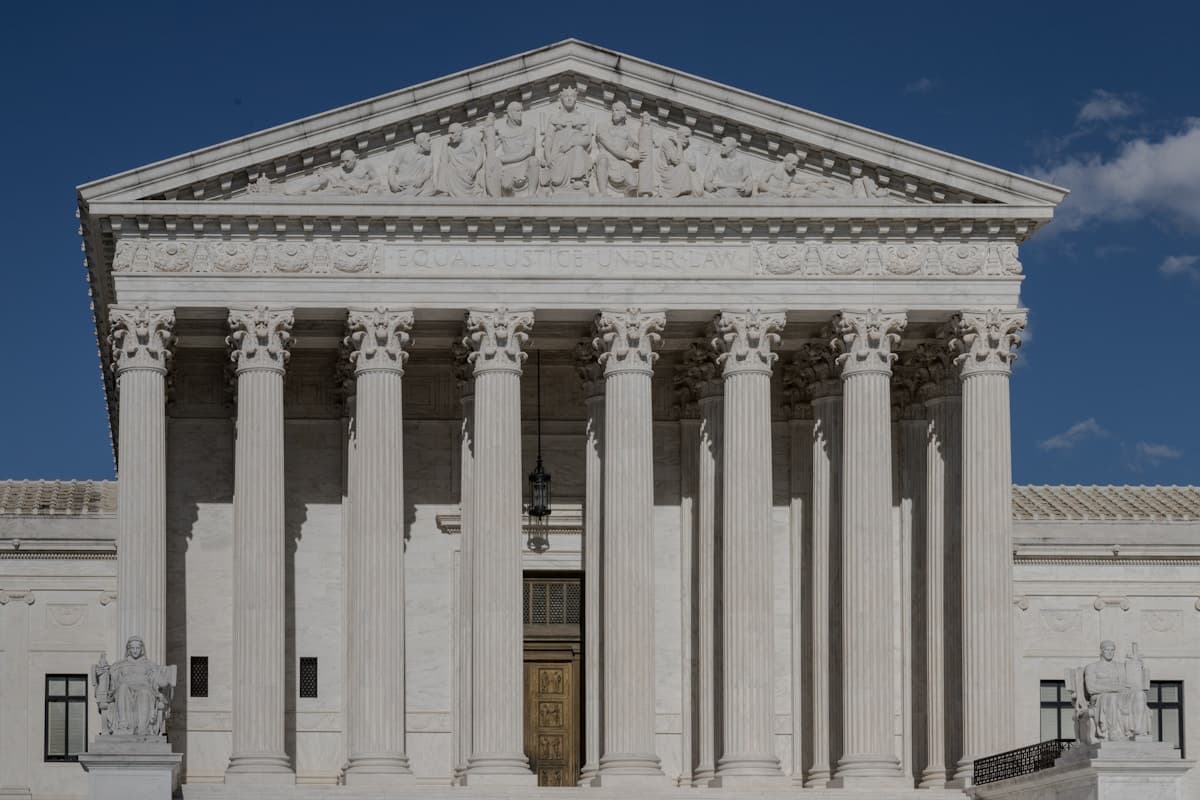
The Supreme Court could hand down one of the most consequential economic decisions in modern American history as early as this week. In Learning Resources, Inc. v. Trump, the justices will decide whether President Trump's sweeping tariffs, imposed under the International Emergency Economic Powers Act (IEEPA), are legal. The court heard oral arguments back on November 5, 2025, and a ruling is expected no earlier than February 20, when the justices return from recess.
The stakes are staggering. Since the tariffs went into effect, the U.S. government has collected approximately $108 billion in duties under IEEPA. Tariff revenue has soared more than 300% compared to pre-tariff levels. If the court strikes down the tariffs, the legal and economic fallout would reshape the global trade landscape overnight.
This isn't just a legal case. It's a test of whether a president can unilaterally restructure the entire U.S. trade system by declaring an emergency.
What Trump Did
The tariff regime at issue is the most aggressive U.S. trade policy since the Smoot-Hawley Act of 1930. Starting in February 2025, Trump invoked IEEPA to declare national emergencies related to immigration and fentanyl, then used those declarations as the legal basis to impose tariffs on imports from virtually every major trading partner.
The numbers are striking. The weighted average applied tariff rate on all U.S. imports has risen to 13.5%, and the effective tariff rate, accounting for behavioral responses, sits at 9.9%, the highest since 1946. According to the Tax Foundation, these tariffs amount to the largest tax increase since 1993, raising federal revenue by $171.1 billion, or 0.54% of GDP.
For American households, the impact is direct. The nonpartisan Tax Foundation estimates the tariffs add an average of $1,300 per household in 2026. Businesses have begun passing those costs to consumers, with JPMorgan estimating that cost pass through rates could shrink from 80% to 20% later in the year as companies absorb what they can.
The Legal Question
The constitutional question before the court is elegant in its simplicity and enormous in its implications. IEEPA was passed in 1977 to give the president emergency powers to deal with "unusual and extraordinary" threats to national security. It was designed primarily for financial sanctions, things like freezing assets of hostile governments or terrorist organizations.
The challengers argue that IEEPA was never intended to authorize tariffs, and that using it to impose duties on trillions of dollars worth of imports is a massive overreach. Two lower courts have already ruled that at least some of the IEEPA tariffs are unlawful.
The case hinges on two constitutional doctrines. The major questions doctrine holds that Congress must speak clearly when delegating authority over issues of vast economic significance. Given that these tariffs affect trillions in trade, the challengers say IEEPA's text is far too vague to support this kind of delegation. The non-delegation doctrine restricts Congress from transferring core legislative powers to the executive without clear standards.
The government's counterargument is that IEEPA gives the president broad authority to "regulate" international commerce during emergencies, and that tariffs fall within that authority. The administration also argues that the courts lack standing to second guess the president's determination of what constitutes an emergency.
The Three Scenarios
Legal experts generally see three possible outcomes, each with very different implications.
Scenario 1: Full strike down. The court rules that IEEPA does not authorize tariffs at all. This would immediately invalidate the entire tariff structure and potentially entitle importers to refunds on the $108 billion already collected. Markets would rally sharply on the news. However, Congress could then pass new legislation specifically authorizing the tariffs, which would take time and political capital.
Scenario 2: Partial invalidation. The court finds that some tariffs exceed IEEPA's authority while leaving others intact. This is what many legal observers consider the most likely outcome. It would create legal uncertainty about which specific tariffs survive and trigger a wave of litigation over individual trade actions. Markets would react positively but with more caution than a full strike down.
Scenario 3: Upheld. The court rules that IEEPA does authorize tariffs under the emergency framework. This would validate the most expansive interpretation of presidential trade authority in modern history and set a precedent that future presidents could use to impose tariffs without congressional approval. Markets would likely sell off on the news as the tariff regime becomes permanent.
The Peterson Institute for International Economics published an analysis suggesting the court's questioning during oral arguments hinted at skepticism toward the government's position, but oral argument signals are notoriously unreliable predictors of outcomes.
The Deal Making Machine
While the legal case plays out, Trump has been rapidly cutting bilateral trade deals to reduce tariff levels for cooperating countries. As of mid-February, 18 jurisdictions have closed deals confirmed by both sides: Argentina, Bangladesh, Cambodia, Taiwan, Ecuador, El Salvador, the EU, Guatemala, India, Indonesia, Japan, Malaysia, South Korea, Thailand, Switzerland and Liechtenstein, the UK, and Vietnam.
The India deal was the headline grabber. On February 2, Trump announced he would cut India's reciprocal tariff from 25% to 18% after Prime Minister Modi agreed to stop buying Russian oil and increase purchases of American energy. Argentina signed a reciprocal trade agreement on February 5. Taiwan reached a deal on February 12.
But the deal making has also shown cracks. On January 26, Trump accused South Korea's legislature of "not living up to its deal" and raised tariffs on Korean autos, lumber, and pharmaceuticals to 25%. Confusion also emerged over the India deal when the White House adjusted language around agricultural goods, with the U.S. removing a reference to pulses, a staple food in India.
The pattern is clear: countries that cooperate on Trump's broader foreign policy objectives (buying American energy, reducing ties with Russia and China) get better tariff treatment. Countries that resist get punished. Trade policy has become an extension of foreign policy in a way not seen since the Cold War.
What the Economy Looks Like Right Now
The tariff regime is producing the exact economic effects that economists predicted, just at varying speeds. GDP growth is slowing, projected at 2.2% for 2026 according to the Congressional Budget Office, down from the roughly 2.8% pace in late 2025. Unemployment is edging up to 4.5%, from 4% in 2024.
Inflation is the tricky part. The tariffs are inherently inflationary because they raise import costs, and those costs get passed through to consumers. U.S. inflation is forecast at 2.7% for 2026, still above the Fed's 2% target. But the Fed is stuck: it can't cut rates aggressively to support growth because inflation is still elevated, and it can't raise rates to fight inflation because that would crush an already slowing economy.
Morningstar warned that "inflation is set to rise in 2026 as tariff costs hit consumers." Stanford's economic research institute noted that the tariff regime creates "policy uncertainty" that itself depresses business investment, because companies can't plan when the rules might change with a single presidential tweet.
What This Week Means
The Supreme Court ruling, whenever it comes, will be a watershed moment. If tariffs are struck down, expect an immediate market rally, a rush by importers to file refund claims, and a political firestorm as Trump would need to work with Congress to reimpose tariffs through legislation.
If tariffs are upheld, expect the administration to accelerate its bilateral deal making while maintaining maximum pressure on holdout countries. China, which faces the highest tariff rates, would see any remaining hope for tariff relief through the courts evaporate.
Either way, the ruling will reshape the relationship between presidential power and trade policy for a generation. The last time the Supreme Court weighed in this decisively on presidential economic authority was the 1952 Youngstown Sheet & Tube case, when it blocked President Truman from seizing steel mills during the Korean War. That decision defined the boundaries of executive power for 70 years. Whatever the court decides this time will do the same.
References
- Did the Supreme Court just signal the fate of Trump's tariffs? - PIIE
- Tariff revenue soars more than 300% as U.S. awaits Supreme Court decision - CNBC
- The $133 Billion Question: Inside the Supreme Court's Historic Tariff Case - Legalytics
- Trump Tariffs: The Economic Impact of the Trump Trade War - Tax Foundation
- What comes next if SCOTUS strikes down Trump's tariffs? - Freshfields
Get the Daily Briefing
AI, Crypto, Economy, and Politics. Four stories. Every morning.
No spam. Unsubscribe anytime.