The Supreme Court Struck Down Trump's Tariffs. He Imposed New Ones the Same Day.
The Ruling That Shook U.S. Trade Policy
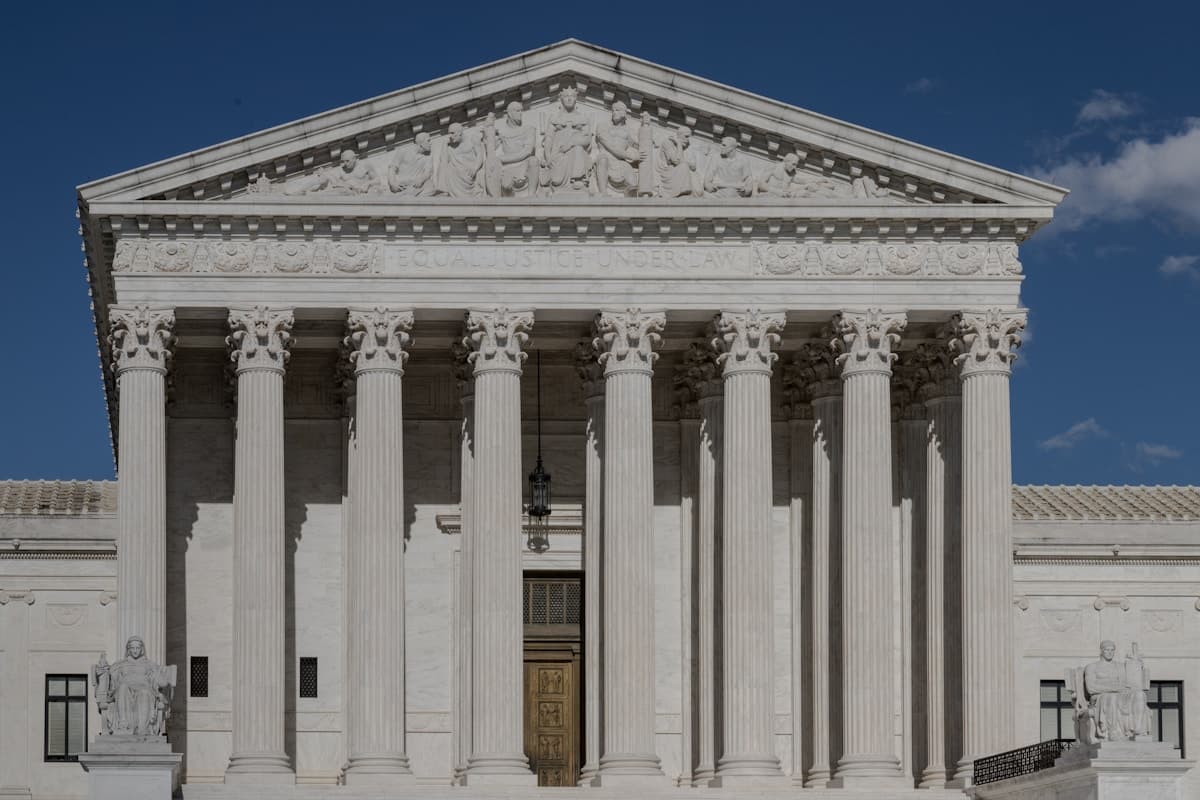
On February 20, the Supreme Court ruled 6-3 that President Trump's sweeping "Liberation Day" tariffs were unconstitutional. Chief Justice John Roberts wrote for the majority: "IEEPA does not authorize the President to impose tariffs." The decision in Learning Resources, Inc. v. Trump ended nearly a year of legal uncertainty over whether a Cold War-era emergency powers law could be stretched to cover trade policy.
The majority included Roberts, Sotomayor, Kagan, Gorsuch, Barrett, and Jackson. Justices Thomas, Alito, and Kavanaugh dissented. The coalition was unusual: three conservative justices joined three liberal ones, reflecting the fact that the legal question was less about ideology and more about the separation of powers. The Constitution gives Congress, not the president, the authority to levy taxes. Tariffs are taxes. The logic was straightforward even if the implications are enormous.
The tariffs had been in effect since April 2025, when Trump declared a national economic emergency and imposed duties ranging from 10% to 50% on imports from virtually every U.S. trading partner. It was the first time in history that IEEPA had been used to impose import taxes.
$133 Billion in Limbo
The most immediate financial question the Court left unanswered: what happens to the $133 billion in tariff duties already collected? U.S. Customs and Border Protection had been pulling in roughly $2 billion per day in IEEPA tariff revenue, and the total collected since April 2025 now exceeds $133 billion. Some estimates put the full disputed amount closer to $290 billion when including all affected jurisdictions and duty categories.
The Court's opinion said nothing about refunds. It didn't order them, didn't prohibit them, and didn't specify a process. That leaves the question to the U.S. Court of International Trade, where importers will need to pursue administrative remedies and litigation. Trade attorneys expect the case to be remanded through the Federal Circuit to the CIT, a process that could take two to three years for most claimants.
NPR reported that companies are already lining up for refunds, but the reality is complicated. Only importers who filed protective protest claims with Customs while paying duties have clear legal standing to recover their money. Large corporations like Walmart, Target, and Home Depot did this. Many small and mid-size businesses did not, either because they didn't know they needed to or because the legal costs weren't worth it. Those companies may never see their money back.
Trump's Same-Day Countermove
Within hours of the ruling, Trump attacked the Supreme Court publicly and signed a proclamation imposing a new 10% "temporary import surcharge" on all imports under Section 122 of the Trade Act of 1974. The next day, February 21, he announced an increase to 15%, the maximum rate allowed under Section 122.
Section 122 allows the president to impose tariffs of up to 15% for up to 150 days to address "large and serious" U.S. balance-of-payments deficits or to prevent significant depreciation of the dollar. The new tariffs take effect February 24 and would expire around mid-July unless Congress acts to extend them.
No president has ever invoked Section 122 before. It was designed for genuine balance-of-payments crises, the kind of situation where the dollar is collapsing in foreign exchange markets and emergency measures are needed to prevent a currency crisis. Critics immediately pointed out that the United States does not currently have a balance-of-payments deficit in the technical sense. The U.S. runs a trade deficit in goods, yes, but it runs a surplus in services and attracts massive capital inflows, which means the overall balance of payments roughly balances by definition.
The Legal Challenge Is Already Coming
Fortune reported that trade experts view the Section 122 tariffs as legally vulnerable for the same reason the IEEPA tariffs failed: the statutory preconditions don't match reality. Section 122 requires a "large and serious" balance-of-payments deficit. The United States has a capital account surplus, meaning more money flows into the country than flows out when you count investment. A trade deficit is not the same thing as a balance-of-payments deficit.
Andrew McCarthy, writing at Reason's Volokh Conspiracy, published a detailed legal analysis arguing that the Section 122 tariffs are just as illegal as the IEEPA ones. The White House fact sheet justifying the proclamation cited the trade deficit as evidence of a balance-of-payments problem, but economists nearly unanimously reject that framing. The trade deficit exists precisely because foreign investors want to put money into U.S. assets, which is a sign of economic strength, not crisis.
New lawsuits are expected within days. The same coalition of importers that challenged the IEEPA tariffs will likely seek an emergency injunction against the Section 122 tariffs, and given the Supreme Court's clear signal about the limits of presidential trade authority, lower courts may act quickly.
The 150-Day Clock
Even if the Section 122 tariffs survive legal challenge, they expire after 150 days unless Congress acts. That puts the deadline around mid-July 2026. For Congress to extend or replace the tariffs, it would need to pass new legislation, which means navigating the same political dynamics that led the administration to use emergency powers in the first place.
The Yale Budget Lab estimates that the effective tariff rate under the Section 122 replacement has settled around 9-10% on average, down from the 10-50% range under IEEPA. JPMorgan analysts cautioned that "trade uncertainty in the coming months will remain elevated" and that "the path forward will be fraught with considerable uncertainties."
For the economy, the Yale analysis projects that even the reduced tariff rate will increase the unemployment rate by 0.3 percentage points by end of 2026, and in the long run, the U.S. economy would be persistently 0.1% smaller, equivalent to about $30 billion annually. The Tax Foundation had previously estimated that full elimination of tariffs would save the average U.S. household about $1,200 in 2026.
What Markets Did
Markets reacted in stages. The initial reaction to the SCOTUS ruling was strongly positive: stock futures surged on the news that the tariffs were struck down. Retail and consumer goods stocks, which had been the most affected by higher import costs, led the rally.
But the rally faded as Trump's same-day Section 122 proclamation sank in. While the new tariffs are lower than the old ones (15% max vs. up to 50%), the message was clear: the administration intends to maintain some level of tariff protection regardless of what the courts say. The net effect for the week has been a modest positive for equities (lower tariff rates are still better than higher ones), some dollar weakness, and continued bond market uncertainty.
Gold has been relatively stable around $3,100 per ounce, but with tariff uncertainty now entering a new phase rather than resolving, some analysts expect continued safe-haven demand.
The Bigger Constitutional Moment
Beyond trade policy, this ruling establishes a significant limit on presidential emergency powers. The Court's message was clear: emergency statutes cannot be stretched to cover policy areas they were never designed for. IEEPA was written to freeze foreign assets and block financial transactions during crises, not to conduct broad trade policy. Using it for tariffs was, in the Court's view, a clear overreach.
This principle extends well beyond tariffs. It signals that courts will scrutinize presidential use of emergency declarations to achieve policy goals that normally require congressional legislation. Immigration policy, financial regulation, technology restrictions: all of these areas where emergency powers have been invoked or considered now face a higher bar.
The 150-day clock on Section 122 means this story has a built-in next act. Either Congress finds the votes to pass permanent tariff legislation (unlikely without bipartisan support), the administration finds yet another legal authority to maintain tariffs (possible but likely to face immediate legal challenge), or the tariffs expire in July and the U.S. returns to something closer to its pre-2025 trade regime. None of those outcomes is certain, which is exactly why businesses and markets are struggling to plan.
References
- Supreme Court strikes down tariffs - SCOTUSblog
- Trump hikes universal tariff to 15% following Supreme Court reversal - The Investor
- After the Supreme Court Ruling, What Is Next for Trump's Tariffs? - Council on Foreign Relations
- Trump's plan B to impose new tariffs is also illegal - Fortune
- State of Tariffs: February 21, 2026 - Yale Budget Lab
Get the Daily Briefing
AI, Crypto, Economy, and Politics. Four stories. Every morning.
No spam. Unsubscribe anytime.